Key Takeaways:
- An industrial portable air conditioner provides flexible cooling for spaces where permanent HVAC systems are impractical or insufficient.
- Choosing the right unit depends on BTU capacity, room size, heat load, humidity, and airflow conditions.
- Portable AC systems can support worker comfort, equipment protection, and operational continuity in high-heat environments.
- Spot cooling and whole-room cooling serve different operational needs and require different deployment strategies.
- Understanding hose configuration, drainage requirements, and mobility features helps facilities select more effective portable cooling solutions.
As summer temperatures rise and facilities face more frequent extreme heat events, maintaining comfortable working conditions has become increasingly difficult in many commercial and industrial environments.
The World Meteorological Organization confirmed 2024 as the hottest year on record, with daytime highs above 40°C (104°F)—and in some regions exceeding 50°C (122°F)—now occurring with growing regularity. The impact on the workforce is measurable: Worker productivity declines by roughly 2–3% for every degree above 20°C (68°F), and the WMO notes that both outdoor and indoor workers are increasingly at risk as extreme heat events grow in frequency and intensity.
Warehouses, manufacturing floors, event spaces, retail environments, server rooms, and temporary structures often experience cooling gaps that fixed HVAC systems cannot fully address. Large open layouts, poor insulation, high ceilings, equipment heat loads, and changing operational footprints all make consistent climate control more challenging.
An industrial portable air conditioner offers a flexible solution by delivering targeted cooling where and when it is needed without requiring permanent HVAC installation. Portable systems can help reduce heat buildup, improve employee comfort, protect sensitive equipment, and support more consistent operational performance during warmer months.
Why Portable Cooling Supports Productivity and Safety
The benefits of a portable air conditioner extend beyond comfort alone. Excessive heat can impact employee concentration, physical performance, and operational consistency.
The International Labour Organization estimates that 22.85 million occupational injuries and nearly 19,000 fatalities each year are tied directly to excessive heat exposure at work. About 35% of employees working in hot conditions face heat-related illness, while poor ventilation can turn industrial spaces into high-risk environments, increasing fatigue and safety issues.
Portable cooling systems can help facilities:
- Improve worker comfort during hot weather
- Reduce heat stress in localized areas
- Protect heat-sensitive equipment
- Improve air circulation
- Maintain more stable indoor conditions
- Address temporary HVAC failures or maintenance downtime
In environments such as server rooms or equipment spaces, portable cooling may also help prevent overheating that could damage critical systems or interrupt operations.
What Is an Industrial Portable Air Conditioner?
An industrial portable air conditioner is a movable cooling system designed to provide temporary, supplemental, or targeted cooling in commercial and industrial environments. Unlike residential portable units, industrial systems are engineered for larger spaces, higher heat loads, and continuous operation.
These units are commonly used in:
- Warehouses and distribution centers
- Manufacturing facilities
- Construction trailers and temporary structures
- Offices with uneven cooling coverage
- Server rooms and IT spaces
- Retail stores and event venues
- Maintenance and repair operations
Many systems use caster-mounted designs for mobility, allowing facilities to reposition cooling as operational needs shift throughout the day or season.
Signs Your Facility May Need Portable Cooling
Facilities often add portable cooling when existing HVAC systems can no longer maintain safe or comfortable temperatures consistently.
Common warning signs include:
| Facility Condition | Potential Impact |
| Hot zones within large facilities | Worker discomfort and productivity loss |
| High equipment heat output | Overheated workspaces or equipment strain |
| Poor airflow in enclosed areas | Uneven temperatures and humidity buildup |
| Seasonal temperature spikes | Temporary cooling gaps |
| Expanding operational areas | Insufficient HVAC coverage |
| Temporary or mobile workspaces | No permanent cooling infrastructure |
Portable systems help address these issues without requiring major facility modifications.
How to Choose the Right Portable Air Conditioner
Selecting a portable air conditioner starts with understanding how and where the unit will be used. Cooling capacity, airflow requirements, electrical service, humidity levels, and building conditions should all be evaluated before making a purchase.
One of the most common mistakes facilities make is selecting a unit based solely on square footage. While area size provides a useful starting point, factors such as ceiling height, heat-generating equipment, occupancy levels, solar exposure, and air exchange can significantly increase cooling requirements.
Buyers should also consider whether the application requires spot cooling or whole-room cooling. Spot cooling directs conditioned air to a specific workstation, production line, or piece of equipment, while whole-room cooling is designed to lower temperatures throughout an enclosed area.
Another frequently overlooked consideration is electrical infrastructure. Higher-capacity portable air conditioners often require higher-voltage power sources, so facilities should verify that appropriate electrical service is available before purchasing equipment.
Finally, environmental conditions matter. Facilities located in humid climates may benefit from models with enhanced moisture-removal capabilities, while warehouses or manufacturing environments with airborne dust may require more frequent filter maintenance and cleaning.
By evaluating these factors upfront, facility managers can avoid common sizing and performance issues while selecting a portable cooling solution that aligns with their operational needs.
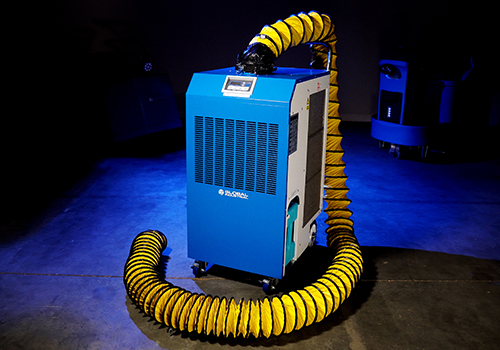
Understanding Portable Air Conditioner Sizes and BTU Capacity
One of the most important considerations when selecting a unit is matching cooling output to the environment.
Portable air conditioner capacity is typically measured in BTUs (British Thermal Units), which indicate how much heat a unit can remove from a space each hour. In commercial HVAC applications, cooling capacity is also commonly expressed in tons, with one ton of cooling equal to 12,000 BTUs per hour. For example, a 5-ton cooling system provides approximately 60,000 BTUs of cooling capacity. In general, higher BTU ratings or tonnage allow an air conditioner to remove more heat, making proper sizing critical for maintaining comfort and performance.
Buyers should also consider the unit's voltage requirements when evaluating portable air conditioners. Larger-capacity units typically require higher-voltage power supplies to support increased cooling output. While smaller portable air conditioners may operate on standard 115V or 120V circuits, larger commercial and industrial units often require 208V, 230V, or higher-voltage connections. Before purchasing equipment, facility managers should verify that the installation location has adequate electrical service available to support the selected unit.
When evaluating portable air conditioner sizes, buyers should consider square footage, ceiling height, heat-generating equipment, occupancy levels, ambient conditions, and available power infrastructure rather than relying solely on floor area.
The following chart provides a general starting point for matching portable air conditioner capacity to the size of the area being cooled. Actual cooling requirements may be higher in facilities with high ceilings, significant heat-generating equipment, direct sunlight exposure, or frequent air exchange.
Portable Air Conditioner Sizing Guide
| Area to Be Cooled* | Typical BTU Range | Approximate Cooling Capacity |
| Up to 500 sq. ft. | 12,000–18,000 BTU/hr | 1–1.5 tons |
| 500–1,000 sq. ft. | 18,000–36,000 BTU/hr | 1.5–3 tons |
| 1,000–1,500 sq. ft. | 36,000–60,000 BTU/hr | 3–5 tons |
| 1,500+ sq. ft. | 60,000+ BTU/hr | 5+ tons |
*Actual requirements vary based on ceiling height, insulation, heat-generating equipment, occupancy levels, humidity, and whether the space is enclosed or open.
While cooling capacity is typically the primary consideration when evaluating a portable air conditioner, refrigerant type can also influence performance and efficiency. Refrigerant is the fluid inside the air conditioner that absorbs heat from the space and transfers it outside the conditioned area. Modern portable air conditioners may use different refrigerants, and some are designed to improve heat-transfer efficiency while also reducing environmental impact. Although refrigerant selection is generally a secondary consideration compared to BTU capacity, tonnage, and voltage requirements, it can help buyers differentiate between similar units when comparing long-term performance and operating characteristics.
Facilities should avoid undersizing units, as overworked systems may struggle to maintain consistent cooling performance during peak heat conditions.
Spot Cooling vs. Whole-Room Cooling
Not all cooling applications require lowering the temperature of an entire room.
Spot cooling focuses conditioned air directly on people, equipment, or workstations. This approach is often more practical in warehouses, manufacturing environments, or large open areas where cooling the entire space would be inefficient or cost-prohibitive.
Whole-room cooling is more common in enclosed offices, retail environments, conference spaces, or temporary structures where maintaining a consistent ambient temperature across the entire room is important.
Choosing between these approaches depends on operational needs, layout, occupancy patterns, and energy considerations.
Single-Hose vs. Dual-Hose Portable AC Systems
Portable AC systems typically use either single-hose or dual-hose configurations.
Single-hose systems use one exhaust hose to remove hot air from the space. These units are often simpler and suitable for smaller or lightly used environments.
Dual-hose systems use one hose for intake and another for exhaust, allowing the unit to cool more efficiently in larger or higher-demand environments. These systems generally perform better in industrial or commercial applications where heat loads are more substantial.
The right configuration depends on room size, operating conditions, and how frequently the unit will run during peak temperatures.
Building a Portable Cooling Strategy for Commercial Facilities
Effective portable cooling solutions are often part of a broader facility heat-management strategy.
Many organizations combine portable AC units with fans, dehumidifiers, spot cooling systems, or temporary airflow improvements to address seasonal cooling challenges more effectively. Facilities with dynamic layouts may also reposition units throughout the day based on occupancy patterns or operational activity.
For warehouses, manufacturing facilities, offices, and temporary workspaces, portable cooling provides a scalable way to improve comfort and operational reliability without major infrastructure investment.
Don't Forget the Consumables and Maintenance Items
Selecting the right portable air conditioner is only part of the equation. Ongoing performance depends on routine maintenance and replacing key consumable components as needed.
For many portable cooling units, air filters are among the most important maintenance items. Dirty or clogged filters can restrict airflow, reduce cooling efficiency, and place additional strain on the equipment. Depending on the environment, facilities may also need to periodically inspect or replace condensate management components, hoses, and other wear items to maintain reliable operation.
Facilities operating in dusty warehouses, manufacturing environments, or construction settings should pay particular attention to preventive maintenance schedules, as airborne particles can accelerate filter loading and reduce system performance.
When evaluating portable cooling solutions, it is helpful to consider not only the initial equipment purchase, but also the availability of replacement filters, maintenance parts, and service support. Factoring these ongoing needs into the buying decision can help maximize equipment lifespan and maintain consistent cooling performance throughout the season.
Frequently Asked Questions
Why is my warehouse still hot even with portable AC units running?
Large open environments, high ceilings, forklift traffic, and heat-generating equipment can reduce cooling effectiveness if units are undersized or improperly positioned. Warehouses often benefit more from targeted spot cooling than attempting to cool the entire space uniformly.
How do I know if my portable AC unit is too small for the space?
Common signs include constant operation without reaching target temperatures, uneven cooling, excessive humidity, or continued heat buildup during peak hours. Heat-generating machinery, direct sunlight, and airflow conditions can all increase cooling demand beyond standard sizing assumptions.
Where should portable air conditioners be placed in industrial facilities?
Portable AC units perform best when positioned near high-heat zones, occupied workstations, or sensitive equipment while maintaining proper airflow and exhaust ventilation. Avoid placing units where airflow is blocked by shelving, pallets, machinery, or walls.
Are portable air conditioners effective in open warehouse environments?
They can be highly effective when used for spot cooling rather than whole-space cooling. In large open facilities, directing conditioned air toward specific work zones or equipment areas is often more efficient and cost-effective than attempting to cool the full building volume.
What causes portable AC units to lose efficiency over time?
Restricted airflow, dirty filters, blocked exhaust hoses, poor drainage maintenance, and operating units outside their intended capacity can all reduce cooling performance. Routine maintenance and proper sizing help maintain consistent operation during high-demand periods.
The information contained in this article is for informational, educational, and promotional purposes only and is based on information available as of the initial date of publication. It is the reader’s responsibility to ensure compliance with all applicable laws, rules, codes and regulations. If there is any question or doubt in regard to any element contained in this article, please consult a licensed professional. Under no circumstances will Global Industrial® be liable for any loss or damage caused by your reliance on this article.