

Forklifts
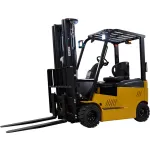

Electric Forklifts
| Compare | Image | Weight Capacity | Fork Length | Raised Height | Voltage | Brand | Model # | Price | |
|---|---|---|---|---|---|---|---|---|---|
-1.webp?t=1790354013000) | 4000 | 42 in | 189 in | 80 | Big Joe | WBB3779340 | $45,539.00 | ||
 | 750 lbs | - | 118 in | 24 V | Big Joe | WBB3120521 | $17,999.00 | ||
 | 3500 lbs | 42 in | 189 in | 120/240 V | Big Joe | WBB3162098 | $46,399.00 |
Electric Forklift Buying Guide
Forklifts are powered industrial trucks used to lift, move, and position palletized materials in warehouses, distribution centers, manufacturing plants, cold storage facilities, and other commercial operations. Electric forklifts are commonly used indoors because they produce no tailpipe emissions during operation and typically generate less noise than internal-combustion forklifts.
Electric forklifts are available in several equipment classes, load capacities, lift heights, mast configurations, and battery types. Class I forklifts are electric rider trucks commonly used for pallet handling and loading. Class II forklifts are designed for narrow aisles and warehouse racking. Class III equipment includes electric pallet trucks, stackers, and other hand or hand-rider trucks.
Before selecting a forklift, consider the heaviest load, load dimensions, required lift height, aisle width, turning radius, lowered mast height, floor conditions, operating temperature, battery runtime, and charger requirements. Rated capacity can change based on load center, lift height, attachments, and load distribution.
Electric forklifts are commonly used in:
- Manufacturing plants
- Loading and receiving areas
- Retail and wholesale storage operations
- Inventory replenishment and order picking
- Food and beverage facilities
- Warehouses and distribution centers
Forklift operators must be trained and evaluated by their employer in accordance with OSHA 29 CFR 1910.178.
IC to E Conversion
The industry has been shifting from internal combustion (IC) forklifts to electric forklifts, thanks to the advancements in battery technology. Stringent emissions regulations and the growing demand for lower operating costs are acting as a catalyst for this transformation. Unlike IC forklifts powered by diesel, LPG, or gasoline engines, electric forklifts use rechargeable battery systems that provide zero tailpipe emissions, quieter operation, and improved energy efficiency. The average charge time on modern lithium-ion batteries has significantly reduced due to better cooling and battery designs.
In addition to drive unit (Engine to battery) hardware changes, the electrical and software architecture requires substantial updates, including battery management systems (BMS), motor control algorithms, regenerative braking, diagnostics, and functional safety features. The resulting electric forklift offers lower maintenance costs, improved operator comfort, reduced total cost of ownership and compliance with evolving environmental regulations, making it an increasingly attractive solution for material handling applications.
Electrified forklifts are extensively used in heavy load handling applications due to their efficiency and quick ROI. Building, lumber, paper handling and big box industries are quick adaptors of this technology.
Big Joe Integrated Lithium-Ion Electric Forklift, 189"H Lift, 4,000 lb. Capacity
Electric Forklift Class Comparison
| Class | Equipment Type | Typical Applications | Key Selection Factors |
|---|---|---|---|
| Class I | Electric motor rider trucks | Pallet handling, loading, unloading, warehouse transport | Capacity, mast height, turning radius, battery runtime |
| Class II | Electric narrow-aisle trucks | High-density storage, narrow aisles, elevated warehouse racking | Minimum aisle width, reach height, lowered mast height |
| Class III | Electric hand or hand-rider trucks | Pallet movement, staging, short-distance transport, low-level stacking | Travel distance, lift height, operator position, load capacity |
Forklift class identifies the general equipment type. It does not confirm that a specific forklift is suitable for a particular load, aisle, rack system, temperature, or operating environment.
Lithium-Ion vs. Lead-Acid Forklifts
| Battery Type | Charging Characteristics | Routine Maintenance | Best-Fit Operations |
|---|---|---|---|
| Lithium-ion | Supports faster charging and opportunity charging when permitted by the manufacturer | Does not require watering or equalization | Operations with frequent use, limited charging time, or multiple shifts |
| Lead-acid | Commonly uses longer scheduled charging cycles | May require watering, equalization, inspection, and ventilated charging procedures | Facilities with established battery rooms and maintenance programs |
Lithium-ion batteries generally require less routine maintenance than flooded lead-acid batteries. Lead-acid systems remain common in facilities with existing charging and battery-maintenance infrastructure.
Battery performance depends on operating hours, load weight, travel distance, temperature, charger compatibility, and the manufacturer's charging instructions. Buyers should confirm whether the battery and charger are included and whether the facility has the correct electrical service.
Access Vehicles and Order Pickers
Access vehicles & Order pickers are designed to increase productivity in warehouse, retail and other industrial or commercial applications. Access vehicles support workers in performing elevated tasks such as order picking, shelf stocking, inventory management, maintenance or assembly. Because access vehicles are designed with simplicity and ease of use for operators they reduce employer exposure to worker injuries resulting from the use of ladders or other fixed platforms while assisting in compliance with general OSHA regulations. Access Vehicles and Order Pickers are available with a wide range of lift heights, load capacities and options, with or without pallet forks.
If a forklift or an access vehicle is a better tool to lift is determined by fitting the aisle and reach the required pallet position without contacting racks, loads, walls, or overhead obstructions. Capacity and lift height alone are not enough to determine compatibility.
Measure the clear operating aisle rather than the distance between rack uprights. The required aisle may depend on the forklift's overall length, load length, turning radius, wheelbase, fork position, and required maneuvering clearance.
Big Joe Joey Zero Electric Access Vehicle, Front Load Capacity 250 lbs, Lifting Height 118" - J0-118
Typical aisle width requirements by forklift type
| Forklift Type | Typical Required Aisle Width | Right-Angle Stacking Aisle |
|---|---|---|
| Standard counterbalance forklift | 11–13 ft | 12–13 ft |
| Access Vehicle | 5–6 ft | 5.5–6 ft |
Actual aisle requirements vary by model. Always use the manufacturer's right-angle stacking aisle specification for the exact unit being considered. These figures are reference ranges only.
Important racking measurements to confirm before selecting a forklift:
- Clear aisle width
- Pallet dimensions and load overhang
- Highest rack beam height
- Pallet height and required lifting clearance above the load
- Lowered mast height
- Extended mast height
- Ceiling and sprinkler clearance
- Door and trailer-opening height
Forklift Dimensions and Specifications
Forklift dimensions determine whether the equipment can move safely through aisles, doors, loading areas, trailers, and storage zones. Buyers should compare the complete dimensional specification, not only capacity and lift height.
| Specification | What It Measures | Why It Matters |
|---|---|---|
| Overall length | Total truck length, sometimes measured with or without forks | Affects turning, storage, trailer access, and aisle requirements |
| Overall width | Widest point of the forklift | Determines clearance through aisles, doors, and work areas |
| Lowered mast height | Mast height when fully lowered | Determines whether the truck can pass through doors and under obstructions |
| Extended mast height | Maximum mast height when raised | Helps identify ceiling, lighting, pipe, and sprinkler conflicts |
| Fork length | Length of the load-supporting forks | Must provide suitable support for the pallet or load |
| Turning radius | Space required for the truck to complete a turn | Helps determine aisle and maneuvering requirements |
| Ground clearance | Distance between the truck and the floor | Affects use on ramps, transitions, and uneven surfaces |
| Wheelbase | Distance between the front and rear axles | Influences stability and maneuverability |
| Load center | Horizontal distance used to calculate rated capacity | Longer or unbalanced loads may reduce usable capacity |
| Free lift | Fork movement available before the mast increases in height | Important in trailers and low-clearance areas |
Confirm whether published dimensions include the forks, load backrest, attachments, or other components. Manufacturers may calculate dimensions differently.
Forklift Capacity Guide
| Rated Capacity | Typical Applications | Common Load Types |
|---|---|---|
| Up to 2,000 lbs. | Light material handling and order picking | Small pallets, cartons, parts, and supplies |
| 2,001–4,000 lbs. | General warehouse and commercial use | Standard pallets, packaged goods, and inventory |
| 4,001–6,000 lbs. | Manufacturing and heavier pallet handling | Machinery parts, bulk products, and building materials |
| Over 6,000 lbs. | Heavy industrial material handling | Large equipment, metal products, and oversized loads |
Choose a forklift based on the heaviest actual load and its dimensions. A forklift's rated capacity typically applies at a specified load center and configuration. Lift height, attachments, and uneven weight distribution can reduce available capacity.
Forklift Lift Height Guide
| Lift Height | Typical Applications |
|---|---|
| Up to 120 in | Low shelving, ground-level storage, loading areas, and elevated access work |
| 121–189 in | General warehouse racking and pallet storage |
| 190–240 in | Taller warehouse racks and distribution facilities |
| Over 240 in | High-bay storage and specialized warehouse systems |
Required lift height should exceed the highest load-placement point. Include the rack-beam height, pallet height, load height, and safe placement clearance. Also verify the forklift's lowered and extended mast dimensions.
Frequently Asked Questions
Have a Question? Our experts might already have the answers.
What forklift capacity do I need?
Choose a forklift with a rated capacity greater than the heaviest load you plan to handle. Consider the load's dimensions, weight distribution, load center, required lift height, and any attachments. A long, uneven, or elevated load may reduce the forklift's usable capacity even when its total weight is below the listed rating.
How high should a forklift lift for warehouse racking?
A forklift should lift above the highest rack beam with enough additional clearance to position the pallet safely. Measure the beam height, pallet height, load height, and required clearance. Also check the lowered mast height, extended mast height, ceiling clearance, and sprinkler locations before selecting a forklift.
How wide does an aisle need to be for a forklift?
The required aisle width depends on the forklift's overall length, turning radius, fork length, load dimensions, and steering design. As a general reference, standard counterbalance forklifts typically require 12–13 feet for right-angle stacking, reach trucks require 9–10 feet, and very narrow aisle trucks can operate in 5.5–6 feet. Always use the manufacturer's right-angle stacking aisle specification for the exact model before configuring your rack layout.
What is the difference between a narrow-aisle forklift and a regular forklift?
A narrow-aisle forklift is designed to work in tighter warehouse aisles and high-density rack systems. Standard counterbalance forklifts generally require more room to turn and position a pallet. Reach trucks and other Class II forklifts can extend loads into racking without turning the full machine, allowing operation in aisles as narrow as 8–10 feet, but are generally intended for smooth indoor floors.
What is the difference between lithium-ion and lead-acid forklift batteries?
Lithium-ion batteries generally charge faster and require less routine maintenance than flooded lead-acid batteries. Lead-acid batteries may require watering, equalization, ventilation, and longer charging cycles. The best option depends on shift length, charging opportunities, operating temperature, maintenance resources, and the facility's electrical infrastructure.
What is the difference between a counterbalance forklift and a reach truck?
A counterbalance forklift uses a weighted rear chassis to offset the load on the forks, allowing it to operate in open aisles without bracing against racking. A reach truck extends the forks into the racking without moving the entire machine, allowing operation in narrower aisles. Reach trucks are generally limited to smooth indoor floors and require less aisle space than standard counterbalance models.
Can electric forklifts be used outdoors?
Some electric forklifts can be used outdoors when the model is approved for the surface and conditions. Check the tire type, ground clearance, gradeability, traction, water resistance, and manufacturer instructions. A forklift designed for smooth indoor floors may not be suitable for rain, gravel, steep grades, or rough pavement.
Do you need a license to operate a forklift?
Forklift operators must be trained, evaluated, and certified by their employer before operating a powered industrial truck. OSHA does not issue a personal government forklift license. Training must include formal instruction, practical training, and an evaluation using the type of forklift and workplace conditions the operator will encounter.
What forklift dimensions should I check before buying?
Check the overall length, overall width, lowered mast height, extended mast height, fork length, turning radius, wheelbase, and ground clearance. Compare these measurements with aisles, doors, rack openings, trailers, elevators, ceilings, and loading areas. Confirm whether the published length includes the forks and any installed attachments.
What should I check before buying an electric forklift?
Confirm required load capacity, lift height, aisle width, turning radius, fork length, lowered mast height, battery type, charger voltage, floor conditions, and operating temperature range. Also review warranty coverage, delivery and freight requirements, charger installation needs, available service and parts support, and OSHA operator training responsibilities before purchase.