Key Takeaways
- Industrial pallet jacks, carts, and hand trucks keep materials moving safely and efficiently across every major industry.
- Using the right tool reduces lifting injuries and boosts productivity on the floor.
- Hand trucks work best in tight spaces with lighter, irregular loads.
- Pallet jacks are built for heavy, palletized goods and warehouse operations.
- Carts and convertibles handle mixed items with flexibility.
- Electric pallet jacks save time and energy on frequent or long-distance moves.
- Specialized models can handle cold storage, clean rooms, or rough terrain.
In many industries, simply getting supplies and equipment from point A to point B is no small task. Whether that’s stacking pallets, restocking store shelves, moving parts around your production line, or delivering goods straight to a customer’s door, the way you move inventory can make or break your efficiency goals.
That’s where material handling equipment like carts, hand trucks, and pallet jacks comes in. They really are the workhorses of your operation, keeping your goods and materials moving smoothly from one stop to the next.
Let’s take a look at which industries rely on these tools the most, why they matter so much, and most importantly, how to choose the right one for the task(s) at hand.
Key Benefits Across Multiple Industries
Before we dive into specific industries, let’s take a quick step back and talk about why carts, trucks, and pallet jacks are so crucial. Regardless of where or why they’re used, the same undeniable benefits consistently emerge. That’s exactly why these tools have become indispensable across so many operations.
1: Efficiency & Productivity
Hauling bulky or awkward supplies and equipment by hand can quickly eat up a ton of valuable time and energy. But with the perfect cart or pallet jack for the job, you can move more in fewer trips and get the job done without barely breaking a sweat. It’s one of those irreplaceable tools that instantly makes the whole operation run more smoothly. And it’s cost-efficient.
2: Safety & Injury Prevention
Back pain and pulled muscles are no joke. Not only do they put your team at risk, but they can also lead to CCOHS violations and costly downtime. Losing trained employees while they recover means reduced productivity and added strain on the rest of your crew. All that constant lifting and carrying takes a toll. According to the Canadian Centre for Occupational Health and Safety (CCOHS): “low back injuries (LBI) account for one quarter of all occupational injuries, and two-thirds of repetitive work injuries in Canada.” Material-handling tools like carts, trucks, and pallet jacks take that strain off your crew.
3: Space Management & Maneuverability
If you’ve ever tried to wedge a forklift into a tight aisle or crowded loading area, you’ll know it can be very frustrating. That’s where hand trucks and pallet jacks come in. Their smaller size and tight turning radius make them perfect for weaving through narrow corridors, packed warehouse floors, or cluttered back rooms where larger machines just can’t go. They help keep operations running without the constant hassles that come with maneuvering bulky equipment.
4: Bastions of Versatility
These tools are about as handy as it gets. Whether you're moving stacked pallets, bulky boxes, or a weirdly shaped something-or-other, there's a cart or hand truck that’s built to do the job. Some models even do double duty, flipping from a dolly to a platform cart, or taking on stairs and rough ground like it's no big deal; because it isn’t.
Industries Benefiting from Hand Trucks, Carts & Industrial Pallet Jacks
While it’s safe to say myriad industries can benefit from them, there are SEVEN in particular that find them invaluable. Let’s break it down.
1: Warehousing & Distribution Centers
This is the most obvious use case, and rightly so. In distribution centers and warehouses, materials are constantly incoming, stored, picked, staged, and shipped. Pallet jacks, hand trucks, and carts are the warehouse equipment that’s used every working hour of every day for:
- Loading & Unloading: Pallet jacks make it easy to move goods in tight docks, trailers, or staging areas where forklifts can’t reach, keeping the process quick and safe.
- Order Picking: Pickers can transport multiple pallets across zones or closer to packing stations, cutting down on extra trips and speeding up workflow.
- Inventory Management & Reorganization: Hand trucks and pallet jacks make it simple to shift stock, reorganize racks, and adjust layouts, even during active operations.
2: Retail & Wholesale
Retail operations, especially the larger locations or big-box stores, constantly need staff to restock the sales floor, move goods from loading docks to storage backrooms, and also handle returns. In wholesale and backroom distribution, pallet jacks and hand trucks are vital for:
- Restocking: Bulky pallets of inventory come into the backroom and must be transported to shelves quickly and efficiently, with as little disruption to the customer as possible. Hand trucks and motorized pallet jacks let staff move stock without causing delays.
- Inventory Control & Returns: When merchandise needs to be moved from storage areas to the floor (or vice versa), or returns are processed, carts and hand trucks streamline everything.
- Direct Delivery: Many retailers now combine in-store fulfillment with direct delivery. Here, hand trucks (usually lightweight aluminum models) are used by delivery drivers to move individual boxes or small loads easily from vans to customers’ doors.
3: Manufacturing Facilities
In factories, the workflow is usually linear, going from raw materials to work in progress to finished goods and products. Carts, trucks, and pallet jacks help maintain that flow by helping with:
- Assembly Line Support: Pallet jacks help get raw materials to the right workstations or carry subassemblies from one stage of production to the next, keeping the workflow smooth and steady.
- Finished Goods Transportation: Once a product is completed, it must be moved to quality inspection, packaging, or shipping areas. Pallet jacks are cost-efficient compared to larger equipment.
- Adaptability: In modular production lines, layouts can often change. Pallet jacks easily adapt without requiring major infrastructure changes.
4: Transportation & Delivery
In logistics and delivery, it’s impossible for large machines like cranes and forklifts to reach every nook and cranny. That’s where pallet jacks and hand trucks really come into their own, especially as this last-mile role is becoming more critical as e-commerce accelerates. They are essential for:
- Truck Loading & Unloading: Especially in tight docks, or when unloading semi-trailers at remote sites, pallet jacks let your crew move pallets in and out without having to rely on a bulkier forklift every time.
- Parcel & Box Delivery: For smaller cargo, hand trucks are literally indispensable. They help delivery personnel move dozens of parcels or boxes between a vehicle and a doorstep, especially when moving up curbs, ramps, or across uneven terrain.
5: Food & Beverage and Hospitality
This sector has its own unique set of challenges: perishable items, cold storage, frequent deliveries, and high service expectations. Let’s look at the benefits in each situation.
Food & Beverage, Grocery and Cold Storage.
- Cold Storage Environments: Specialized pallet jacks (with materials suitable for freezing conditions, low-temperature lubricants, corrosion-resistant parts) are essential in refrigerated warehouses and freezer rooms where standard equipment would fail.
- Beverage Delivery & Grocery Distribution: Lightweight, high-mobility hand trucks (often made of aluminum) are used to deliver cases, kegs, or crates. The ability to move such loads from trucks or walk-ins down aisles into coolers or freezers is central.
Hospitality (inc. Hotels, Restaurants, and Event Venues)
- Supplies & Equipment Movement: From stacks of linens and cleaning supplies to boxes of food, provisions, and back-of-house storage, hand trucks are constantly in use in hospitality.
- Furniture & Large Items: For everything from commercial events and refurbishments, to banquet setups and even weddings, heavy-duty hand trucks help move chairs, tables, appliances, and/or staging equipment with ease.
6: Healthcare
Hospitals, clinics, and pharmaceutical providers also have a unique set of requirements. And as you’d expect, hygiene, safety, and precision are of the utmost importance. Carts, trucks, and jacks assist with:
- Medical Equipment & Supplies: Oxygen tanks, carts of medicinal supplies, delicate diagnostic equipment, and bulk deliveries all need to be moved safely around hospital floors. Hand trucks with cleanable surfaces, corrosion-resistant materials, and smooth rolling casters are essential.
- Pharmaceutical & Lab Logistics: Some loads are delicate, temperature-sensitive, and often require strictly sterile conditions. Specialized pallet jacks or carts (e.g. stainless steel, sealed bearings) are essential in clean rooms or warehouse areas that support these crucial healthcare supply chains.
- Internal Logistics: What does that cover? Think anything from linens and laundry to central sterile processing. Hospitals rely on these carts to move trays, bins, and containers safely and securely throughout their facilities.
7: Automotive & Repair Workshops
In the automotive and repair industries, parts and motors can not only be cumbersome, but come in a vast assortment of shapes and sizes. You need versatility here for:
- Parts Storage & Retrieval: Engines, transmissions, and subassemblies are often on pallets or in bulk bins. Pallet jacks let you move them easily within the warehouse or shop floor.
- Workshop Use: Within a garage or workshop, carts or hand trucks are used to move tool chests, replacement parts, and accessories. Because spaces are tight and layout changes happen often, flexibility is key.
- Mobility in Bays: Sometimes, mechanics and crews must deliver parts directly to a service bay on a cart or platform truck, working deftly around lifts, ramps, and other shop equipment.
Choosing the Correct Hand Truck, Cart, or Pallet Jack
Decisions, decisions. Picking the right hand truck, cart, or pallet jack can save a ton of time and headaches before you even hit the shop floor. But where do you begin? What are the strengths of each tool, and do you need just one, or a combination of all three? Don’t worry—we’ll break it down for you.
Hand Trucks
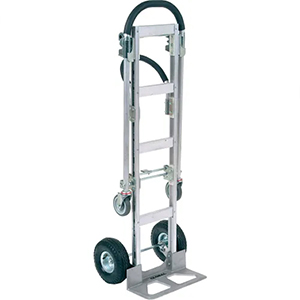
Hand trucks are your go-to when you’re moving lighter items. Boxes, bins, small appliances, or even furniture fit right in.
You’ll love a hand truck if:
- You often work in tight, cramped spaces like offices, storage rooms, or narrow corridors.
- Portability and keeping costs low are important to your business model.
- You need to move supplies up or down stairs (some models even climb stairs).
- Your loads don’t sit on standard pallets.
| Strengths | Limitations |
|---|---|
| Lightweight, maneuverable, flexible, and budget-friendly. | Not the best for weighty loads or constantly hauling large quantities. |
Industrial Pallet Jacks
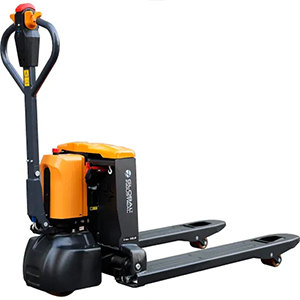
Available in either manual or electric models, pallet jacks are invaluable in warehouses, docks, and retail backrooms.
Reach for a pallet jack if:
- You’re often moving big, unwieldy loads.
- You regularly load or unload trucks and trailers.
- You handle large volumes or repeat lifts (focus on electric pallet trucks to save your back and boost efficiency).
- Your loads fit standard pallets (48 by 40 inches).
| Strengths | Limitations |
|---|---|
| Makes pallet moves efficient, reduces labor, built for intensive work. | Needs more room to maneuver, not ideal for unusually-shaped loads. |
Carts (or Convertible Hand Trucks & Platform Carts)
Carts are the all-rounders; the cart-of-all-trades, so to speak. They’re perfect if your items are a mix of boxes, bins, and loose goods that don’t live on a pallet.
Carts come in handy if:
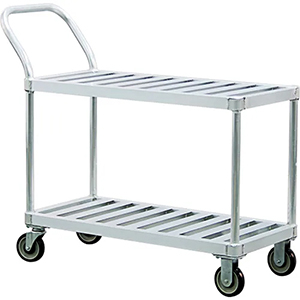
- You need flexibility beyond a hand truck, but don’t always need full pallet support.
- You want a tool that can switch between cart mode and platform/truck mode.
- Your primary moves aren’t pallets but still need some of that mechanical muscle.
| Strengths | Limitations |
|---|---|
| Versatile, handles mixed loads, and is a smart and affordable middle-ground option. | Not made for substantial pallet loads; there are a few more moving parts to watch. |
Final Quick Checklist: Your Key Decision Factors
Still not sure which way to go? Before you decide, think about how and where you’ll actually be using the equipment. These few key factors can make all the difference when choosing the right tool for the job:
Checklist: Key Decision Factors
- Load weight & type: Small, odd-shaped loads lean towards hand trucks or carts, whereas large pallets call for a pallet jack.
- Space & maneuverability: Hand trucks excel in tight aisles. Pallet jacks need room for forks and turning.
- Cost & maintenance: Hand trucks are cheaper and simpler to maintain. Electric pallet jacks may have more components, but they do save labor.
- Environment: Rough terrain, outdoor use, freezer zones, or clean rooms may need special models with wide wheels or corrosion-resistant finishes.
- Usage frequency & distance: Occasional moves? Select a hand truck. Constant pallet moves across long distances? Opt for an electric pallet jack to save your team’s backs (and improve their morale).
Frequently Asked Questions (FAQs)?
Q: Which industries use pallet jacks the most?
A: Warehousing, retail, manufacturing, delivery, hospitality, healthcare, and automotive.
Q: What’s the difference between a hand truck, cart, and pallet jack?
A: Hand trucks move small or odd-shaped loads. Carts handle mixed goods. Pallet jacks move materials and supplies on pallets.
Q: When should I choose electric over manual?
A: Choose electric if you move massive loads often, especially across long distances. Manual works fine for smaller or occasional jobs, but be sure to stress the importance of manual pallet jack safety to the crew.
Q: Can pallet jacks work in cold or wet areas?
A: Yes, but make sure you choose corrosion-resistant or freezer-rated models for those environments.
Q: What is the standard pallet jack capacity?
A: Most manual pallet jacks hold about 5,000 pounds, which is standard for most models. Heavy-duty or electric models can handle even more.
Q: Are there options for stairs or uneven ground?
A: Yes. Rough-terrain pallet jacks and stair-climbing hand trucks are specifically made for those conditions.
Q: How often should these tools be inspected?
A: Check daily for safety and do a more detailed inspection weekly.
Q: Can these tools help reduce workplace injuries?
A: Yes. They minimize lifting, lower strain, and help you maintain CCOHS compliance and avoid violations.
So, that’s our comprehensive breakdown of the industrial applications for carts, trucks, and pallet jacks. It’s a lot, we know. Feel free to reach out to one of our experts, who will be happy to help you select the perfect fit for your facility.
The information contained in this article is for informational, educational, and promotional purposes only and is based on information available as of the initial date of publication. It is the reader’s responsibility to ensure compliance with all applicable laws, rules, codes, and regulations. If there is any question or doubt in regard to any element contained in this article, please consult a licensed professional. Under no circumstances will Global Industrial® be liable for any loss or damage caused by your reliance on this article.